
The Affordability Crisis
There are things we can’t afford that are more important than eggs and bus rides


The great raconteur and friend Richard Rubin wrote recently — he loves to pop off random emails when Trump gets his gander up — arguing that the affordability crisis is real. “We do have an affordability crisis,” he said. “We cannot afford Trump much longer.”
It was a witty play on words that inadvertently opened the Overton window on the topic of “affordability” to encompass something much larger than the price of eggs. The word itself has reordered political dialogue since “Zorro” Mamdani launched his blitzkrieg campaign for New York mayor. In a free-market economy run on the principles of supply and demand, of course, not everything will be “affordable” to everyone; the sustainable solution is to increase supply, not make it free. Nonetheless, Mamdani’s mantra struck a chord, particularly with Millenials and Zoomers. More than the cost of a bus or an apartment, the idea of affordability connected with a deeper, subconscious anxiety about our collective future, especially among young people.
Zoomers are pessimistic, if not downright depressed. Look at this snapshot of Gen Z’s attitude about the direction of the country, driven by anxiety about financial insecurity, intense political polarization and the rise of AI, among other factors.
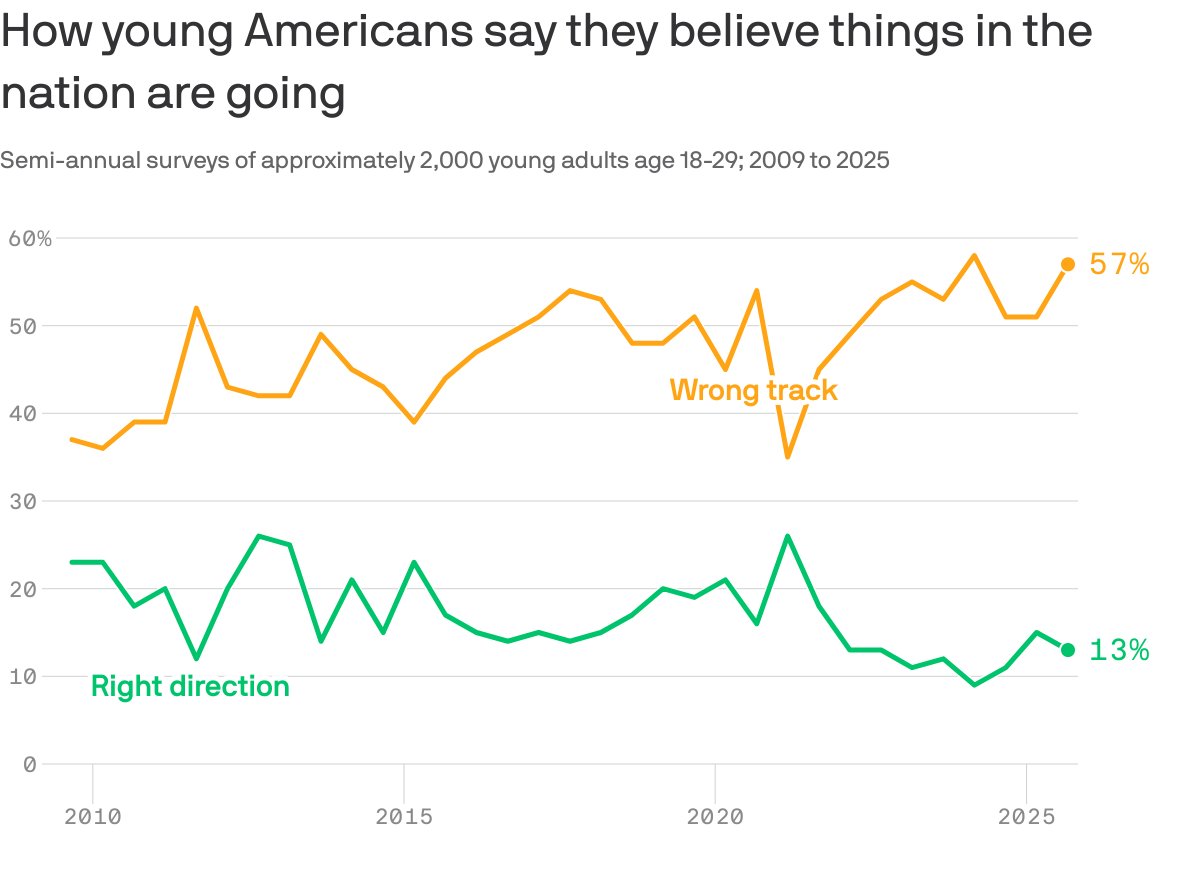
This is not the way to lean into the future, and it’s why the notion of affordability has struck such a chord. If we think about it for a minute, most of us realize that we can’t afford the future we’ll have if we continue down this road. It’s this idea of affordability that my friend Richard stumbled on — one that is larger, longer-term and more existential than the cost of groceries. In this Overton window, there are a few basic things that we simply cannot afford.
Failing Schools. As Ben Sasse pointed out in the Wall Street Journal this week, our schools are failing the future. Education is the foundation for society itself. It drives innovation, creativity, discovery and growth. And increasingly, schools are failing to deliver. “The number of freshmen entering the University of California San Diego whose math skills fall below a high-school level has increased nearly 30-fold over the past five years, according to a shocking new report from the university’s Senate-Administration Working Group on Admissions,” wrote Sasse. “(This) means the U.S. has millions of recent high school graduates and 20-somethings who are unprepared to navigate modern work and life, and lack the logical problem-solving skills with which algebra has traditionally armed adolescents.” And it’s not just math. About 65 percent of college freshmen today have reading skills below basic proficiency levels. We can’t afford an education system that fails so many young people.
The National Debt. I know — yawn. Let’s just print more money. But the debt crisis, slow-moving though it is, presents a clear and present danger to our domestic tranquility and national security. We know it’s there; we just prefer to invoke the Satchel Paige rule. “Don’t look back,” he said. “Something might be gaining on you.” That would be the national IOU coming due. Rolling Stone’s Matt Taibbi once described Goldman Sachs as a “great vampire squid wrapped around the face of humanity.” He was so wrong. That’s not a vampire squid; it’s the national debt, sucking capital away from schools, social services, national defense, R&D, and so much more. We’re not serious about it. We’re trotting out ideas like a 50-year mortgage (a small vampire squid unto itself) or using tariffs to replace the income tax instead of paying down our debt. Several European countries have already reached the tipping point, where the national debt is eating up entitlements and social benefits. America isn’t far behind. We can’t afford a future of indentured servitude.
Polarization. Can we just talk to each other? Apparently not, which is one of the reasons why the government shut down for 43 days this year, furloughing around 800,000 federal workers, disrupting services like national parks and food assistance programs, and draining $15 billion a week from the economy in lost productivity and GDP growth. Not to mention that we can’t talk to Uncle Harry about politics at the dinner table without devolving into a fog of condemnation and echo chambers. Social discourse has turned into a barbell, weighted down by extremes at either end with a slender and diminishing connecting rod that is the middle ground. We can’t afford a future where we don’t bridge differences to build common solutions.
The Commons. At the turn of the century, Robert Putnam famously called us out for “Bowling Alone,” by which he meant the collapse of social institutions and cultural norms — the commons — that bind us together. Church attendance, particularly mainline churches, is down; even among those who still belong, weekly attendance is declining. Volunteerism is dropping; in the county where I live, most fire departments are staffed by volunteers, and they can’t recruit and train enough to meet demand. Membership in civic organizations has dropped by 50 percent since the 1960s. And that most sacred foundation of the commons — trust — has collapsed across the board. We can’t afford a future where we don’t make time or space to nurture the common good.
Relativism. At the beginning of the 20th century, Einstein published his theory of relativity, which shook the foundations of science. By the 1920s, noted the historian Paul Johnson in “Modern Times,” the theory had migrated into the broader culture, the belief that, “for the first time at a popular level, that there were no longer any absolutes: of time and space, of good and evil, of knowledge, above all of value.” Relativism has metastasized in the 21st century to the point that Luigi Mangione is hailed by some as a hero for gunning down UnitedHealthcare CEO Brian Thompson on the streets of Manhattan, and almost 40 percent of Gen Z believe that political violence is acceptable under some circumstances. Relativism is the foundation of cryptocurrency, where the only value is what the other guy thinks it is; today, the President of the United States has made almost $3 billion from selling crypto. We’re at peak relativism, where absolutes — whether it’s the value of a human life or the underlying value of a financial asset — are always negotiable. We can’t afford a future without some shared bedrock beliefs.
So, yes Richard, we do have an affordability crisis, but it goes beyond groceries and presidents. Can we afford a future that is the logical outcome of our current actions? We all know the answer. What’s needed is sustained, multigenerational leadership to course correct. And not just a single leader, some white knight leading us to Valhalla; it will take all of us, literally. We are, after all, what we make of ourselves. So, let’s get to work.
You did a great job calling out the core issues. I completely agree, and would add the broader cost of healthcare and insurance. People forget how transformational the ACA was—flawed, yes, but a massive improvement over what we had before. It’s overdue for meaningful updates. I could name plenty of other affordability problems, but pointing them out is simple—figuring out actual solutions in this political environment seems impossible.
Russ, this is an excellent summary of our current state of affairs, one of your best -- thanks!